
Mark Elias / Democracy Docket
Published: December 17, 2025
Copyright /Shared by JSNE Active Subscription Rights / See Fair Use Statement Below
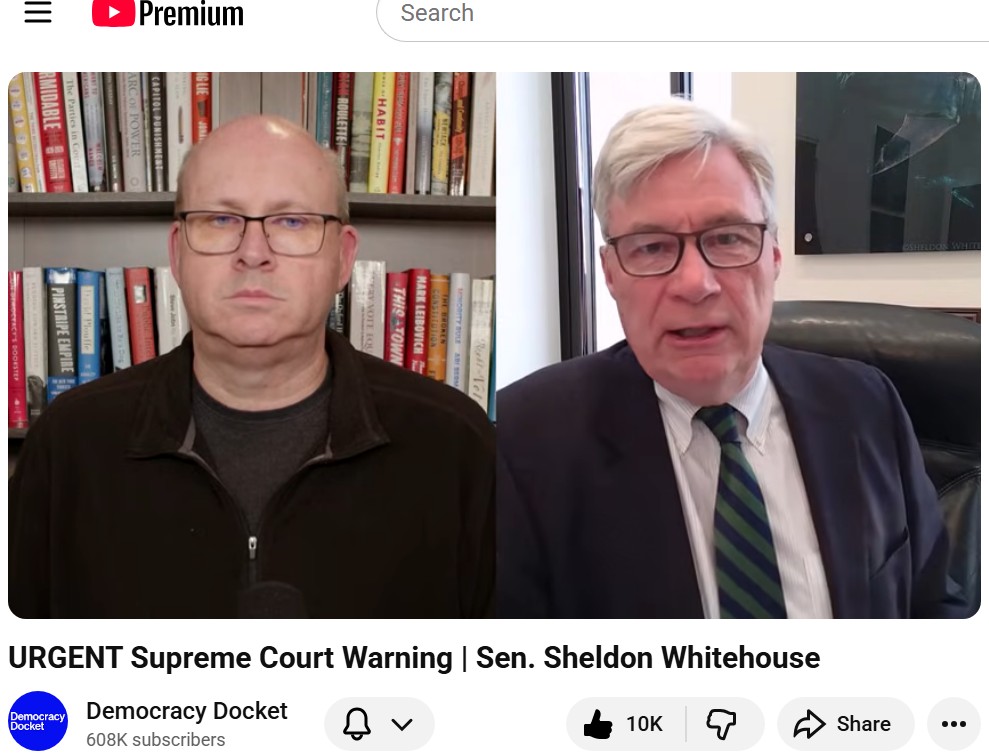
| Sen. Sheldon Whitehouse is one of the nicest people in politics — unless you’re the fossil fuel industry. He joins me today to discuss the Republican healthcare failure, how the Supreme Court was captured by dark money, and what we can do to fix it. Hint: it involves looking into Justice Clarence Thomas’ luxury motor home. This interview has been edited for length and clarity. |
| Marc Elias: Senator Sheldon Whitehouse, welcome back to Defending Democracy. Senator Whitehouse: Thank you very much, Mark. It’s wonderful to be with you again. Marc Elias: It is great to see you and we have a lot to cover, but I want to start by extending my condolences to your home state of Rhode Island where we have again seen another mass shooting, this time at Brown University, one of the premier colleges and universities in the country. I don’t even know what to ask you or what to say other than there have now been more than 400 mass shootings in 2025. And I know you and your colleagues on the Democratic side of the aisle have done everything you can to try to curb this. I assume that you’re going to tell me that you’ve gotten thoughts and prayers from Republicans in the Senate and in Congress, but no movement on any legislation. Senator Whitehouse: I think the immediate thing that I would ask anyone listening is if you have opinions on what the motives for this incident were, keep them to yourself. It’s not helpful now to the families who have injured kids, who have murdered kids, and who are going through all of this trauma and sorrow and drama right at the beginning of the holidays to have a bunch of people with big mouths and no good thoughts trying to butt into all of this. Let the investigation proceed. We’ll find out who did it. We’ll find out what their motive was. And in the meantime, there’s simply no call for a lot of completely unjustified and completely unnecessary political dramatization of this. So just shut up if you don’t have anything knowledgeable to say. Marc Elias: Providence is a wonderful place. I have had the chance to visit there. I’ve never lived there. My family members who have recently moved there just rave about what it is as a city. And obviously, Brown I’m very familiar with as one of the premier universities. So as someone who has obviously spent a lot of time in Providence and around Brown University, just tell us a little bit about the city, about what the university is like, so that people can appreciate just what a terrible tragedy this is for a wonderful place to live. Senator Whitehouse: Yeah, it’s a truly wonderful city. It’s one of the culturally richest cities anywhere. As a result, I think it has the best food and restaurants for its size of any city in the country. And it’s big enough to have lots of great stuff going on. I went and listened to the Messiah at the Veterans Memorial Hall over the weekend, and it was a spectacular presentation. It was a big city presentation, and yet it’s a small enough place that people know each other. And if you don’t know somebody, you know somebody who knows them. So it combines that kind of closeness and kindness and feeling of integration of a small town with a lot of the assets of a big city. In that sits Brown University at the top of the hill above downtown. And Brown is very integrated into the city. The streets of the city go through it. You can walk through it to do shortcuts. It’s a campus that is as incorporated into the city around it as any that I have ever seen. So for this to happen at Brown is painful for a great number of people in Providence for whom this is their neighborhood. This isn’t something that happened over there at Brown. This is something that happened, right? The church I went to Sunday morning is probably three lateral blocks from the scene of the shooting. This has hit people very hard. And again, I’ll emphasize, people on the internet shooting off their mouths about stuff that they don’t know anything about are doing nothing but causing pain and distraction. And they should just at least shut up until the investigation is done. At least shut up through the holidays. Marc Elias: We are all thinking about you and thinking about the people of Providence and Brown and your state. And so I wanted to start with that. But let me jump to why I originally wanted to have you on. You have been one of the keenest observers of this Supreme Court. And I recently had an opportunity to argue before the Supreme Court. It is the end of the year. There are a number of important cases there. And frankly, I think I did a good job. I think I have a chance of winning. But the universal sentiment is that this Supreme Court didn’t take a settled question of campaign finance law that they ruled on in favor of the law in 2001 to simply issue a medal and congratulate us all for having such a strong law that they were probably bringing it to overturn that. We of course have the Louisiana case that we’re all waiting on, the big voting rights case where section two of the Voting Rights Act is at issue. The argument in the FTC case about whether or not Congress is setting up independent agencies — whether that’s gonna now be struck down. I could go on and on, Senator, but it seems like this is a term where the conservatives are just looking at established precedent after established precedent for overturn. Senator Whitehouse: I think you have to look at all these cases as they come up in the context of this being a captured court. And when I say captured, that’s a term of art. You talk about agency capture, where the old robber barons who owned the railroads would make sure that the railroad commission was stacked with their flunkies so they got whatever they wanted. Agency capture has existed for a long, long time. And it was just the recent right-wing billionaire barons who took that strategy and applied it to the Supreme Court. It’s been a work of maybe two or three decades, but it has led to a captured court. And that captured court does what is expected of it. It does what is expected of it, not only because it’s expected, but because those same individuals, those same big right-wing trusts, those same corporate flaks come into the court in every case that matters to them, and they tell the court what to do through a flotilla of front groups. You had 25 right-wing front groups who filed briefs in that case. And that was a coordinated effort, a chorus of harmonizing noise from the folks who captured the court to remind the court exactly what it is that they want in this case. And what you see from that captured court and from those constant instructions is outcomes that are completely reliable in three areas. One, the more dark money the better. The more billionaire political influence, the better. So that’s one, dark money. The second is voting rights. The more that local legislatures are allowed to suppress votes, the more that the politicians control who votes and who votes for them, the better. And the third is polluter’s rule. And any regulatory effort to get at polluters or to restrict their pollution, this court resists all the way up to this recent case to allow the president to fire independent agency chiefs, even if they’re in the middle of a term of office, which moves the point of decision making in a regulatory case to the Oval Office. Where the president can take a big bribe from a big special interest and then send the instructions down to his personally appointed deciders to offer a decision in favor of, in the usual case, the big polluter. But all of these things converge into that narrative, and we have to always remember that narrative. Marc Elias: So explain to me, and I think people who are listening to this, I think they understand the money and politics part. That’s pretty straightforward. I think they understand the voting rights part. Why do those interests want there to be less expertise at agencies, less insulation? Why do they want less fixed terms? You’re a Senator and I assume when you guys pass legislation, you think about these agencies structured a certain way. So how is it that the bad guys here want to change that structure that you guys have in place with these expert independently run agencies? Senator Whitehouse: They want to change it so that in the decision making process, there is more politics. They call it accountability. But the fact of the matter is that if a regulatory agency makes a decision, it is immensely accountable for that decision. In time, people can be rolled off the agency body and appointed by a new president. If they’ve done something really wrong, they can actually be fired for cause. When the rule comes out, it gets automatically set up for congressional review if any member of Congress wants it. There’s a Congressional Review Act that allows for an automatic privileged review of new agency rules. When agency rules come out, the agency has to come before the Appropriations Committee and defend its decisions in those matters, and we can always overturn a rule by legislation. What you have is, Congress tried to create an honest and independent and expert place in which decisions would be made on the merits and the experts of the industry could be treated levelly by experts for the public as opposed to just political stooges and rollovers. And that’s what they want to undo. They want all of that political accountability after the fact, once that independent high integrity process is concluded, to be polluted before the fact so that they can get in the decision that they want. And my favorite number in all of this is $700 billion, which is the latest estimate from the International Monetary Fund of how big the subsidy is for fossil fuel in the United States of America every single year from being allowed to get away with polluting for free. So the stakes are immense when you’re talking about a $700 billion annual subsidy. Marc Elias: So when Donald Trump and the Republicans talk about how the free market works and how EVs and solar and wind shouldn’t be subsidized, you’re saying actually it’s fossil fuels that are being subsidized. Senator Whitehouse: Totally, probably by 100 to one. There are direct subsidies for fossil fuel, and you can argue about what the number is. It’s probably in the 70 to 80 billion dollar a year range. But the big one is the indirect subsidies of being allowed to pollute for free. It simply is wrong, obviously morally — we all know that, you spill the milk, you clean it up — but it’s also wrong economically. Even the most right-wing economists like Milton Friedman said if you have a negative externality — if you’re hurting somebody else — the cost of that should be baked back into the price of the product. Otherwise, it’s a subsidy, and fossil fuel has for generations lived off the subsidy of being allowed to pollute for free. And they are behind, I think, the dark money aspect of this, the voting rights aspect of it, because they’re more tied into the Republican Party. So if they can defeat Democrats, better for them. And of course, they are the direct polluters. So pollution regulation drives them crazy with resentment. Marc Elias: So we have a 6-3 court, and it’s pretty clear how that stacks up. What do you think that the liberal justices should be doing? Should they be trying to find points of compromise? Should they be calling this out? How do you view the liberal contingent on the court? Senator Whitehouse: For a long time I was pretty disappointed with the liberal contingent on the court because I thought they were very trapped in the immediate decision in front of them. The famous Justice Brandeis started writing briefs that brought into his amicus briefs social and economic data. That’s called by lawyers a Brandeis brief. My briefs take it the next step and look at the politics and the influences and the special interests around a particular thing, right down to who’s behind the amici in that case, right behind who’s behind the litigating group in that case, right behind pointing out that this is actually kind of faux litigation that was cooked up by these groups. And this wasn’t a real plaintiff who tried to win a case and ended up in the Supreme Court. This is all a factory level thing to get a case and a question in front of a Supreme Court that they know is captured. So I put all of that in. And I think that the liberal justices could be doing a better job of pointing out what’s going on here. In this case, what I’m looking for is to see whether they point out that the Citizens United decision, which is kind of the linchpin of all of this in terms of the right of Congress to protect against corruption versus First Amendment rights to speak, was wrongly decided. And it stands on a false factual premise, which is that all this money that they unleashed was gonna be transparent. They said voters will know who’s behind all the creepy advertisements. And of course, we’re at $8 billion of dark money disproving that fact. And you can show in the analysis that without that fact, the whole analysis collapses. So far, the liberal justices have never pointed out that factual problem with Citizens United and pointed at the court for its failure to correct a plain factual clear error for 15 years now, likely because it benefits the people who put them on the court and are writing all those creepy flotilla front group briefs. Marc Elias: You’re right that in the case I argued in the court, there were 25 amicus briefs on the other side. And some of them are organizations I never heard of, which is weird. Like the Chamber of Commerce filed a brief. Why would the Chamber of Commerce file a brief to change the amount of money that political parties can spend in politics? Senator Whitehouse: Why would the Chamber of Commerce become a worst climate obstructor? Because fossil fuel gives enormous money to the Chamber of Commerce, and they become a huge dark money intermediary. They accept dark money, not just dues from their regular payers, but dark money, and then they take that money and they go forward and they become the intermediary in politics and doing dark money ads for those guys. And I’m convinced that they’re doing this for fossil fuel because they get huge bucks from fossil fuel to do that, to screen from the public who’s really making this argument. So it looks like the Chamber of Commerce, which locally are always really the nice local business community folks. And this one rents out that label, that mask to whatever bad player wants to come into the court without showing their own hand and having the Chamber of Commerce do their dirty work for them. Marc Elias: So the other recent news that I wanted to get your take on was the comments that we now have seen that have come out of Trump’s Chief of Staff, Susie Wiles, in which she says that maybe she had a deal or she thought she might have a loose understanding with the president that there would be a misuse of the Department of Justice for retribution for only 90 days, but he went on beyond that and who could blame him? You’re a former state attorney general for Rhode Island. You are a former U.S. attorney for Rhode Island, a very prominent lawyer and part of the prosecution criminal justice system. Do you feel like she gave it away by saying that this was going on at all? What do you make of this? Senator Whitehouse: Yeah, it was probably a bit of a dumb admission on her part. And it’s not really the MAGA thing to do, because the MAGA thing to do is just to keep lying, no matter what the evidence. And when you’re confronted with things that prove that you’re lying, you just go louder with the same lies and get angrier. And that’s a political strategy. It’s a sort of rhetorical strategy, not a very elegant one. It’s the way they roll. But when you get into court, when you’re the Department of Justice and you’ve got responsibilities to the public and to the larger sense that justice must be done, then you’re supposed to behave yourself a lot better. And the Department of Justice has been an absolute fountain of flagrant misbehavior, and you can measure it in innumerable ways. Multiple instances of prosecutorial misconduct that then don’t get investigated because they don’t want to have an investigation. The whole mess with Lindsay Halligan and her fake indictments of James and Comey. But then you go to courts across the country. And Marc, you’ve been a lawyer for a long time, and you want, when you come into court, you want to have your reputation, your firm’s reputation, be one that is respected, and where people think you can be trusted to be an honorable advocate, and the judges can buy what you have to say. And that’s more important for the Department of Justice than it is even for private lawyers. But if you look at the things that regular district judges are saying about this Department of Justice, talking about contempt, talking about pretextural arguments, talking about assertions that have no factual basis. These are things when I was U.S. Attorney, if my federal court had said this about any of my prosecutors, we’d have been having meetings, that would have been a fire alarm. You never, never, never want to have a federal court say the kind of things about the Department of Justice that are regularly, frequently, commonly said by U.S. federal judges about this DOJ. Marc Elias: Yeah, and it’s being said, by the way, by not just judges appointed by Biden and Obama and Clinton, it’s being said by judges appointed by both parties, including some appointed by Donald Trump in the first term. Senator Whitehouse: Yeah, absolutely. It’s kind of stunning. I mean, if you don’t know that and you’re just used to listening to political combat and high level invective and people saying mean things about each other, it may not sink in that when a federal judge says this about an attorney practicing before him, particularly an attorney practicing for the Department of Justice before him, that is really rare. That is really exceptional and unheard of. And it is happening so regularly now, it’s really pretty stunning. Marc Elias: How much do you worry about the next batch of Trump-appointed judges? You are probably the leading voice in the Senate caucus on the Democratic side about the courts and capture and corruption and just problematic appointees. I don’t know if you’ve even had his first round of appointees, but we haven’t heard as much about it. Senator Whitehouse: Yeah, some are coming through. It’s kind of a mishmash between the traditional Koch brothers, Leonard Leo, Americans for Prosperity, fossil fuel crowd that they usually go with that produced Gorsuch and Kavanaugh and Barrett and Roberts and Alito. And now there’s a separate MAGA movement that wants a different kind of judge in there, a Trump loyalist judge, not just somebody who’ll do the faithful thing for the fossil fuel industry that funds them. And so there’s a bit of a clash now between those two groups and that was represented by Donald Trump calling Leonard Leo a sleazebag who probably hates America, which is kind of a riot to hear when Leonard Leo and the creepy billionaires behind him probably picked all of Trump’s Supreme Court nominees. I think he’s only now figuring out that he was the chump in that transaction. I think there was a deal back then where the Koch brothers who hated Trump would shut up and let him run his campaign and would plow money into Republican field operations and leave him alone. In return, he would let them pick his Supreme Court justices because they cared more about the court than any other branch of government. And now I think he’s catching on that these people were actually picked by Leonard Leo and Don McGahn who were only nominally working for him, but were really part of the court capture Koch brothers’ operation. So that combat is very much coming up. It’s one thing to have a judge who will rule for the fossil fuel industry because that’s what they do. Take a look at the Boasberg contempt hearing. That was stopped by two Trump circuit judges doing something very weird, taking an administrative stay process that usually lasts for hours, days, maybe a week, and holding the thing in abeyance for four months, really, during which the Department of Justice shoved Emil Bove, one of Trump’s thug lawyers, through the confirmation process in the Senate and onto the Third Circuit Court of Appeals. I don’t know what happened behind the scenes, but let’s just say somebody made a call to those two Trump judges and said, “Keep your administrative stay in place, slow walk this, we’ve got a guy we want to put onto the court and we don’t want the record of his contempt.”So you get into things like that where you may be seeing Trump judges meddling in the process in order to take advantage and gain advantage for MAGA, which is a slightly different order of a problem than just having a huge lien in all your cases for dark money, polluters, and voting limitations. Marc Elias: The point the Senator is making is a really important one. Judge Boasberg wanted to do contempt proceedings with respect to his orders halting the deportation flights abroad to El Salvador. And normally this is not the kind of thing the Court of Appeals would get involved in at this stage at all. But the case was stayed under a procedure that is routinely used by Courts of Appeals to stay things that are imminently going to happen where the court just needs a beat to make a decision. And the fact that this was an administrative stay for months, I mean, I never heard of such a thing. Senator Whitehouse: And particularly when it lined up perfectly with getting the thug lawyer, Emil Bove, onto the court to be a Trump judge on the Third Circuit. The coincidences are pretty stunning. And then, of course, if you’re a lawyer and are interested in this and want to dig in more, go back and read the decisions of Judge Rao and Judge Katsas, the two Trump judges, and compare that to the dissenting judge — Judge Pillard. And the first two are almost comic book nonsense. And her dissent is just really brilliant, clear, sharp, trenchant legal analysis of the first order. And you just put those things side by side and it really is the gong show versus the real judge. Marc Elias: Do you think your Republican colleagues know when they confirm someone like Bove what they’re doing or do they not care? Senator Whitehouse: You know, I think they must. And I think some of them have some hesitation about it. Some just say, “Well, everybody appoints losers sometimes, and elections have consequences, and Trump got elected, so he should get what he wants, even if the guy’s a loser.” But I think there really is some anxiety. In the case of Bove, the record doesn’t reveal it, but during his nomination’s hearing, both Attorney General Bondi and Deputy Attorney General Todd Blanche came over and sat behind him in the hearing room to give the hairy eyeball to the Republicans to let them know that they were watching and that this was their guy and we want him through. I have never seen that kind of a public display of pressure for a judicial nominee. There was intense pressure being put on the Republicans to make sure this guy Bove got through, because there was plenty of disqualifying information on him. Marc Elias: One other legislative matter before we talk a little bit of politics. So it seems like the Republicans are tied in a knot over healthcare. They don’t seem to know what they’re doing or what to do. What is the latest you can tell us about where things stand? Senator Whitehouse: The Republicans are completely tied in a knot. They have never cared about healthcare except to be against Obamacare. They were against Medicare when it started. They were against Medicaid when it started. Now they’re against affordable care credits. But they’re not really for anything that they would actually want to put out there to their voting public because they’d see what a wreck their supposed plan was. Even Trump said he had a concept of a plan. We’re not even seeing a concept of a plan right now. They’ve got a speaker saying under no circumstances will we extend affordable care credits. And they’ve got, I don’t know, 15 vulnerable Republican House members saying, “For God’s sake, please extend affordable care credits. Otherwise, we’re all gonna lose our races, and this is gonna be terrible for our party.” So there’s a war happening within the Republican Party about this political question, and it has no substantive or policy backdrop behind it that they can agree on, because they’ve never in all of these years sat down and put out a coherent, thoughtful healthcare strategy that anybody in America would want. Marc Elias: Obviously we’ve seen very positive results in some off-year elections, New Jersey, Virginia, Georgia, New York, all around the country. What do you think we need to both be hopeful for and worry about? I’m hearing a lot of people, and I among them, are worried about whether Donald Trump tries to interfere in the 2026 elections. You see the mid-cycle redistricting, and by the way, someone’s paying for all that. And then on top of that, you have just a flood of money coming into right-wing groups already to try to influence 2026. So what’s your sense of where we’re going? Senator Whitehouse: I think that Trump has burned through his public goodwill very rapidly by being so rash and chaotic and indulging himself in ridiculous projects like a new ballroom and not paying attention to the healthcare issue and not paying attention to inflation and not paying attention to homeowners insurance and not paying attention to electric utility costs, all of that. So he’s in a very weakened position and that gives him much more motive to engage in political bad tricks and mischief than even before when he had plenty. And of course he’s got Russians who’ve always helped him, who are willing to help him again. In Trump 2.0, we’ve pulled down many of the institutional safeguards that protect America from foreign interference. We’ve basically let the gates down to allow the Russian raiders more readily into our internet, into our internal American conversations, to get funding through all of that. So there’s real opportunity for mischief. But I think my feeling is that if we call it out and we can connect not only the cost problem that families are facing, but the corruption that is very often behind the cost problem, that is enough for people to say, “I put my faith in this guy, but he just didn’t.” And this can be a change election in the same way that, frankly, most recent elections have been change elections. And this change will go back towards the Democrats. But I think we’ve really got to keep the pedal to the floor on the cost issues that regular American families are facing and the corruption piece of why they are facing those costs. Marc Elias: If you want to hold Donald Trump accountable, if you want better courts, put this guy in the majority. Sheldon Whitehouse is Donald Trump’s worst nightmare. He is the Koch brothers worst nightmare. He is the people who are trying to destroy this democracy’s worst nightmare. So elections have consequences. So tell us a little bit about what you see as what the priorities should be if and when Democrats are back in charge. Senator Whitehouse: Well, I think clearly the priorities are gonna be to go back and solve the Republican created healthcare nightmare that is about to just thrash millions of American families. It gets worse soon as the trillion dollars in Medicaid cuts that Republicans did in order to help fund their billionaire tax cuts. That’s a comparison that I don’t think voters are gonna love when they see those Medicaid cuts start to land. Now they postponed most of them past the election to try to dodge that accountability, but what they forgot is that nursing homes, hospitals, and doctors practices have to have financial plans. And as they look forward to these looming Medicaid cuts, they’ve got to start thinking about, “Do I need to go into receivership? Do I need to throw out these customers? Do I need to dump all my Medicaid customers? Can we stop doing these different services?” It’s going to start showing up very soon in the healthcare infrastructure that people depend on. And I think we’re going to have to go to work to make sure that that healthcare infrastructure is supported and rebuilt because this wave of damage in healthcare that is coming at us is going to be very profound. Everybody’s so intoxicated by Trump and his nuttiness and all of the noise and drama that he causes that they haven’t really kind of taken a calm look at, “Wow, when you take this much money out of the healthcare system, where does that go?” And it lands always at the providers, at the nurses, at the doctors, at the nursing homes, at the hospitals, at the doctor’s offices. And so I think our first order of business is gonna be to set that right.Second, clean up the tax codes so it’s not so crooked for billionaires. Billionaires are fine. They can pay their damn taxes. We should do that. There’s a huge cleanup at the court that’s required, and we’re gonna have to get serious about climate change, because it’s about to tear apart the insurance sector, which tears down mortgage markets, which crashes property values, and we’re in the early stages of that cascade. So, just a few little things. Marc Elias: I hope you’ll take on the polluters. You identified them as one of the problems. The idea that the fossil fuel industry is getting subsidized is insane. I know you’re going after them. Senator Whitehouse: Oh yeah, absolutely. Climate change problem is caused by the fossil fuel industry, but now it’s not about polar bears and green jobs or any of that kind of stuff. Now it’s about people’s insurance companies telling them, sorry, your home is unsafe for us to insure any longer, we’re withdrawing our insurance, or we’re doubling your rates, or if you want to renew with us, you gotta put a new roof on your house for $40,000. It’s becoming very, very real in a lot of families’ finances that climate change is no longer some hypothetical political issue to kick around. It is risk and it is cost and it is danger and it is coming through their mail slot from the insurance companies. Marc Elias: The Biden administration made a big to do about putting together a task force on the Supreme Court. And then it seemed like they came to the conclusion not to do anything about the Supreme Court. I’m not sure why they bothered with the task force to do nothing. So tell everyone what a serious effort looks like because we need reform. Senator Whitehouse: Yep, totally got buried. It was so bad that Lawrence Tribe of Harvard and Nancy Gertner, a very respected retired federal judge weren’t allowed to express their criticisms in the Biden report. They had to file an op-ed the day that the report was made public because they wouldn’t even let them be dissenting views. That’s how much the Biden administration tried to cover for this captured Supreme Court. The two things that need to be done are really quite simple. One is they need a proper code of ethics. And it’s not a proper code of ethics if nobody does any fact finding. If you bring an ethics charge against me in the Senate, there are people in the Senate Ethics Committee who do an investigation. With the Supreme Court, we never even get to find out what happened. They just don’t answer questions. Nobody ever investigates. So that is really essential and that is the heart of a proper ethics code. The second is, I think we have to go to term limits. The public wants term limits. If you do 18-year term limits and make it retroactive, you start the refreshing of the court immediately, and then you pick up little nasty things that get finished when you do it this way. The judges, particularly the Republican judges, say they’re all above politics, but when do they resign? Only during a Republican administration. So it’s like, “Yeah, I’m really above politics, except when I help pick the next seat, I make sure that my party gets it.” So that belies the whole above politics thing. And then, as you know, very, very often they’ve got this sort of duty to sit theory, which means that even if they have a conflict of interest, they have to sit on the case because that changes the numbers and therefore it could change the outcome. Well, with term limits, the term limited ones can go on what we all know is basically senior status. They’re still around. They’re also there as a backup bench so that when a judge who’s deciding appellate cases has a conflict of interest, you don’t have to have a judge decide a case with a conflict of interest. They can go out, you bring in somebody with no conflict of interest from the senior status group. And so it solves those two problems for the court, as well as giving it a refresh and also putting regular appointments so people know that there’s going to be an appointment coming up. It just adds a lot of order in what is now politically driven chaos. And most importantly, the public is really, really desirous of seeing that happen. Marc Elias: If you and I went to lunch and we had an expensive lunch, I wouldn’t be able to pay for your lunch. These justices travel the world in the summer, as far as I could tell, at the expense of God knows who. And I don’t understand. Why are they not subject to the same gift limits that you’re subject to? Senator Whitehouse: It would be pretty easy to do, but there’s no enforcement. There’s not even any. So here’s a really simple example. Clarence Thomas was loaned over a quarter of a million dollars to buy for himself a very expensive luxury motor home. And he made a few payments on it, interest only. And then the donor behind the loan said, “You know what, call it forgiven. No more interest, no more principle.” So he never paid a dollar of principle. And any tax lawyer knows that when a loan is forgiven, that is an incident of income. That is a reportable thing. So we know that he did not report it on his judicial forms as income. That kind of opens a pretty reasonable inquiry as to whether he reported it on his tax forms as income. And even with that question being repeatedly asked over years, he has never given an answer about did he pay taxes on it, when he paid taxes on it, and where’d the money come from that paid his taxes on that. The fact that the court shields itself from answering so simple a question about whether one of its members is actually engaged in tax fraud is a sign of how badly the reform is needed over there. Marc Elias: Senator Whitehouse, it is always a pleasure to have you. It’s always great to see you. Senator Whitehouse is also one of the genuinely nicest people in politics that you’ll ever run across. Senator Whitehouse: Unless you’re the Koch brothers or the fossil fuel industry. Marc Elias: He probably doesn’t want you to know that because it hurts his image, but thank you, Senator, for being here. |